The number one mistake new YouTubers make isn't their camera quality or their editing. It's starting a channel without understanding the competitive landscape of the niche they're entering. They pick a topic they love, upload for six months, then wonder why nothing is growing.
The fix is simpler than most people think: use real data before you commit. This guide shows you how to pick a YouTube niche the smart way — using analytics to validate demand, assess competition, and spot growth opportunities that aren't obvious to everyone else.
What Makes a YouTube Niche "Good"?
A good niche has three things: real audience demand, manageable competition, and monetization potential. The worst niches either have no audience, are so crowded you can't get traction, or attract an audience that doesn't buy anything. Most people only think about the first one.
The best YouTube niche isn't necessarily the one you're most passionate about — it's the one where your passion meets an underserved audience.
Step 1: Use Category Analytics to Understand the Landscape
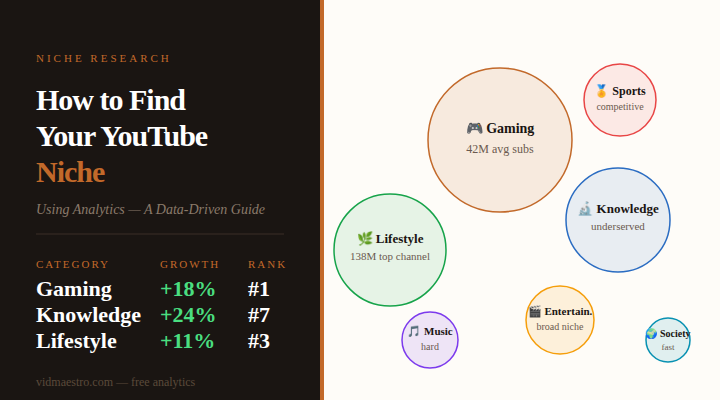
Before you decide on a niche, you need to see what's actually performing on YouTube right now. VidMaestro organizes YouTube into seven major categories with real-time top-lists: Gaming, Music, Sports, Entertainment, Lifestyle, Society, and Knowledge.
Browse VidMaestro's category charts and pay attention to how many subscribers the #10 vs. #50 channel has. A sharp drop-off means the top is saturated. A gentler curve means the middle is more accessible — and that's where new channels can actually grow.
Step 2: Find the Sub-Niche Within the Category
Winning at "gaming" or "lifestyle" is essentially impossible if you're starting from zero. But winning at "PC building tutorials for beginners" or "solo female travel in Southeast Asia" is entirely realistic. Sub-niches are where channels actually grow.
Use VidMaestro's channel analyzer to search for channels in your area of interest and look for these signals:
- Channels under 500K subscribers with high views-per-video relative to their size
- Channels that upload consistently and are growing month-over-month
- Topics that appear repeatedly in successful channels but aren't covered to death
- Gaps — questions and topics the audience keeps asking that nobody's answered well yet
Step 3: Validate with Competitor Data
Once you've narrowed to a sub-niche, add 5–8 channels in that space to your VidMaestro competitor dashboard and look at them collectively.
Is the category growing or shrinking?
If most channels in your target sub-niche are gaining subscribers month over month, that's a healthy signal. If growth is flat or declining across the board, the audience may be moving somewhere else.
Where is the competition clustered?
Are most channels in the 100K–500K range, with very few below 50K? Check upload dates on those channels — if many of them started in the same year, you'll know when the niche peaked.
What's the upload frequency sweet spot?
How often do the fastest-growing channels in your niche post? Some niches reward daily uploads; others perform better with one well-produced video per week. Match the cadence to what works, not what's easiest for you.
Step 4: Check Monetization Viability
Views are nice. Revenue is better. Finance, business, and tech channels typically earn 5–10× more per view than entertainment or gaming channels due to higher advertiser demand. Think about your niche in terms of who is watching, what they might buy, and whether there are sponsorship opportunities in the space.
The Niche Validation Checklist
Before you commit to a direction, run through this:
- I can name at least 5 channels in this niche — and they're all growing
- There are sub-niches or angles none of them are fully covering
- I could make at least 50 video ideas in this niche without repeating myself
- The audience has spending power (there are sponsors or products in the space)
- I can sustain content output in this niche for 12+ months without burning out
- VidMaestro's category charts show the niche is healthy, not declining
The Most Underrated Niche Strategy: Go Where the Audience Is Moving
The best time to enter a niche is just before it peaks, not after. Use VidMaestro to spot channels that are growing unusually fast relative to their size — these are often in emerging sub-niches that haven't hit mainstream yet. If you can establish yourself there early, you'll ride the wave up instead of chasing it.
The data is all there waiting for you. All it takes is looking in the right place — and VidMaestro makes that as simple as it gets.